DESERT GALLERY
Montello Foundation Competition
Honorable Mention
Partner: Victoria Graziano
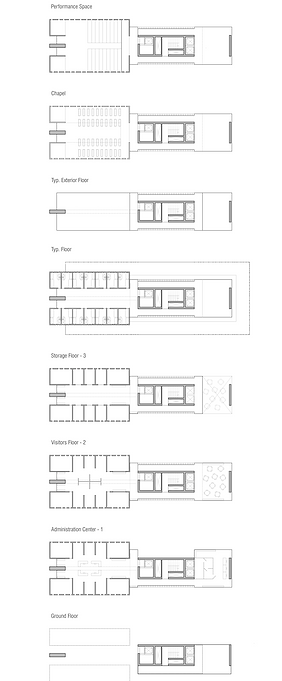
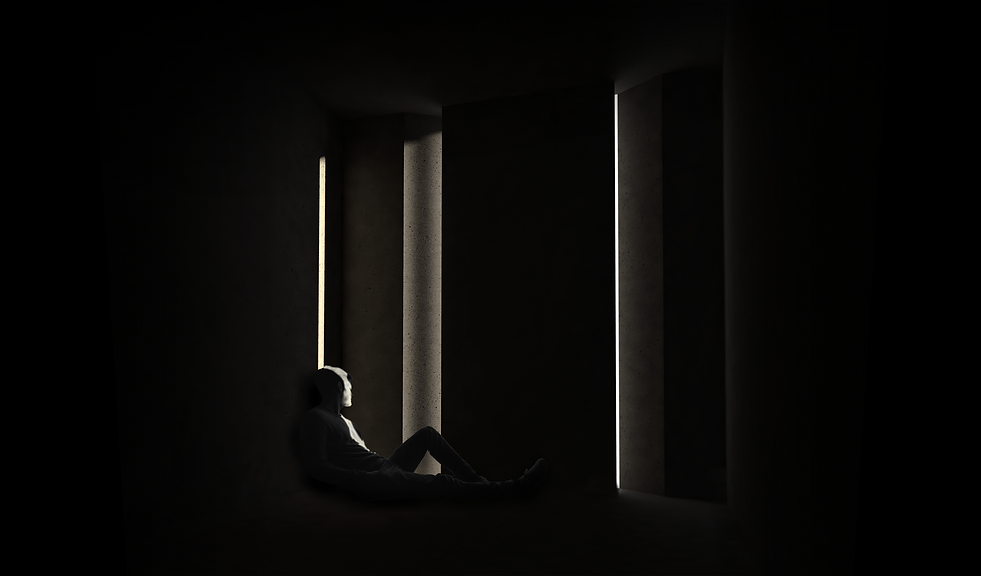
Traditionally, an exhibition space serves to frame presented works of art. Here the structure exhibits both the artwork "within" produced by the artists, and the artwork without, being the natural world. As one approaches or passes by , the structure maintains a continuously changing opacity where the desert environment and the core materialize and dematerialize to the viewer. This renders the desert environment as an active participant in terms of exhibition, where it simultaneously frames the structure and is framed by it as a work of art.
Space and people filter through the field of timber elements towards the art that is nested within the rammed earth core of the structure. The timber elements touch the earth lightly and the rammed earth core of the space is made of the same soil as the surrounded desert. This responds to the site in terms of building economy and sustainability and it generates an osmosis of light and space that guide one through a procession
DESERT GALLERY
Montello Foundation Competition
Honorable Mention
Partner: Victoria Graziano
Traditionally, an exhibition space serves to frame presented works of art. Here the structure exhibits both the artwork "within" produced by the artists, and the artwork without, being the natural world. As one approaches or passes by , the structure maintains a continuously changing opacity where the desert environment and the core materialize and dematerialize to the viewer. This renders the desert environment as an active participant in terms of exhibition, where it simultaneously frames the structure and is framed by it as a work of art.
Space and people filter through the field of timber elements towards the art that is nested within the rammed earth core of the structure. The timber elements touch the earth lightly and the rammed earth core of the space is made of the same soil as the surrounded desert. This responds to the site in terms of building economy and sustainability and it generates an osmosis of light and space that guide one through a procession
DESERT GALLERY
Montello Foundation Competition
Honorable Mention
Partner: Victoria Graziano
Traditionally, an exhibition space serves to frame presented works of art. Here the structure exhibits both the artwork "within" produced by the artists, and the artwork without, being the natural world. As one approaches or passes by , the structure maintains a continuously changing opacity where the desert environment and the core materialize and dematerialize to the viewer. This renders the desert environment as an active participant in terms of exhibition, where it simultaneously frames the structure and is framed by it as a work of art.
Space and people filter through the field of timber elements towards the art that is nested within the rammed earth core of the structure. The timber elements touch the earth lightly and the rammed earth core of the space is made of the same soil as the surrounded desert. This responds to the site in terms of building economy and sustainability and it generates an osmosis of light and space that guide one through a procession
DESERT GALLERY
Montello Foundation Competition
Honorable Mention
Partner: Victoria Graziano
Traditionally, an exhibition space serves to frame presented works of art. Here the structure exhibits both the artwork "within" produced by the artists, and the artwork without, being the natural world. As one approaches or passes by , the structure maintains a continuously changing opacity where the desert environment and the core materialize and dematerialize to the viewer. This renders the desert environment as an active participant in terms of exhibition, where it simultaneously frames the structure and is framed by it as a work of art.
Space and people filter through the field of timber elements towards the art that is nested within the rammed earth core of the structure. The timber elements touch the earth lightly and the rammed earth core of the space is made of the same soil as the surrounded desert. This responds to the site in terms of building economy and sustainability and it generates an osmosis of light and space that guide one through a procession
DESERT GALLERY
Montello Foundation Competition
Honorable Mention
Partner: Victoria Graziano
Traditionally, an exhibition space serves to frame presented works of art. Here the structure exhibits both the artwork "within" produced by the artists, and the artwork without, being the natural world. As one approaches or passes by , the structure maintains a continuously changing opacity where the desert environment and the core materialize and dematerialize to the viewer. This renders the desert environment as an active participant in terms of exhibition, where it simultaneously frames the structure and is framed by it as a work of art.
Space and people filter through the field of timber elements towards the art that is nested within the rammed earth core of the structure. The timber elements touch the earth lightly and the rammed earth core of the space is made of the same soil as the surrounded desert. This responds to the site in terms of building economy and sustainability and it generates an osmosis of light and space that guide one through a procession
DESERT GALLERY
Montello Foundation Competition
Honorable Mention
Partner: Victoria Graziano
Traditionally, an exhibition space serves to frame presented works of art. Here the structure exhibits both the artwork "within" produced by the artists, and the artwork without, being the natural world. As one approaches or passes by , the structure maintains a continuously changing opacity where the desert environment and the core materialize and dematerialize to the viewer. This renders the desert environment as an active participant in terms of exhibition, where it simultaneously frames the structure and is framed by it as a work of art.
Space and people filter through the field of timber elements towards the art that is nested within the rammed earth core of the structure. The timber elements touch the earth lightly and the rammed earth core of the space is made of the same soil as the surrounded desert. This responds to the site in terms of building economy and sustainability and it generates an osmosis of light and space that guide one through a procession
BELMONT PRISON
The justice system in the United States is largely organized around profit and perpetuates the vicious cycle of incarceration without regard to proactive solutions. The goal of this project is to design a prison on Belmont Island, a small islet between Queens and Manhattan directly south of Roosevelt Island, that addresses the basic question of how we collectively treat those among us that go astray.
1- Punishment in terms of prison, involves isolation from greater society as a way of imposing generally agreed upon values. Ideally punishment and reform work hand in hand to enforce moral structure, keep people safe, and hopefully improve the character of the offender.
2- This duality of punishment and reform should express itself architecturally. There should be a clear distinction between spaces of isolation and spaces of reform.
3- There is a gradient of offenses people commit against society, and thus should be reflected in programmatic organization and spatial hierarchy where prisoners are organized in accordance with their offenses.
4- Punishment and reform should correlate with isolated and open space. This should also speak to the relationship of the ‘interior; of the prison to the city around it.
5- While the prison should be removed from profit motive, prisoners should be productive to maintain and build their character. This can involve general or specific education, training, and therapy. This will allow prisoners to be positively reformed and positively contribute to a greater society once they are free.